How Should a Nonprofit Executive Director Prepare to Leave? Part 1: Why a Succession Plan Isn't Enough
Last updated September 2026
When I started my last executive director job, I was handed a folder with a few random documents. A staff member walked me through the server files, and someone gave me a printed spreadsheet of passwords with about half of them crossed out.
Don't get me wrong. I had a wonderful team that helped get me oriented. But there was no handoff.
I don't tell that story to criticize the person who came before me or my former organization. Nobody meant any harm. There was just no structure to work from, and I kept thinking there had to be a better way.
In a planned transition, the months before you walk out the door are some of the most important leadership work you will ever do. What you build in that window is what your successor walks into on day one, and it carries your name long after your email address is turned off.
This is Part 1 of a two-part series. Here I'll cover why this work matters right now and what separates a leadership transfer from succession planning. Part 2 covers where to start and the five stages I teach in The Legacy Leadership Transfer.

Why does preparing to leave matter so much right now?
A lot of nonprofit leaders are leaving their roles, and many organizations are not ready for it. Government and nonprofit organizations recorded more CEO exits in 2025 than any other industry, burnout concern among nonprofit CEOs jumped sharply in 2026, and fewer than a third of nonprofits reported a written succession plan in BoardSource's latest published study.
Here are the numbers behind that:
427 CEO exits. Government and nonprofit organizations led every industry in CEO departures in 2025, with 427 exits (down from 493 in 2024), according to Challenger, Gray & Christmas's year-end 2025 CEO Turnover Report, published February 2026.
46% of nonprofit CEOs said their own burnout is "very much a concern," up from just under 30% the year before, in the Center for Effective Philanthropy's State of Nonprofits 2026 report, released May 2026 from a February 2026 survey.
29% of organizations had a written succession plan or policy to guide the board through a chief executive transition, according to BoardSource's Leading with Intent report (June 2021), the most recent edition with a published figure.
Here is the part that surprises people. Even the organizations in that 29% are not covered for what I am about to describe.
Succession plan vs. leadership transfer: what's the difference?
A succession plan is the board's governance plan for filling the executive role: who steps in, how the search runs, and how the organization stays steady. A leadership transfer is the departing executive director's own preparation to pass on what she personally carries. They solve different problems, and a healthy transition needs both.
This is the distinction I see missed most often. Boards assume a succession plan covers the whole transition. It covers the seat. Nothing in it captures what is in the head of the person sitting there.
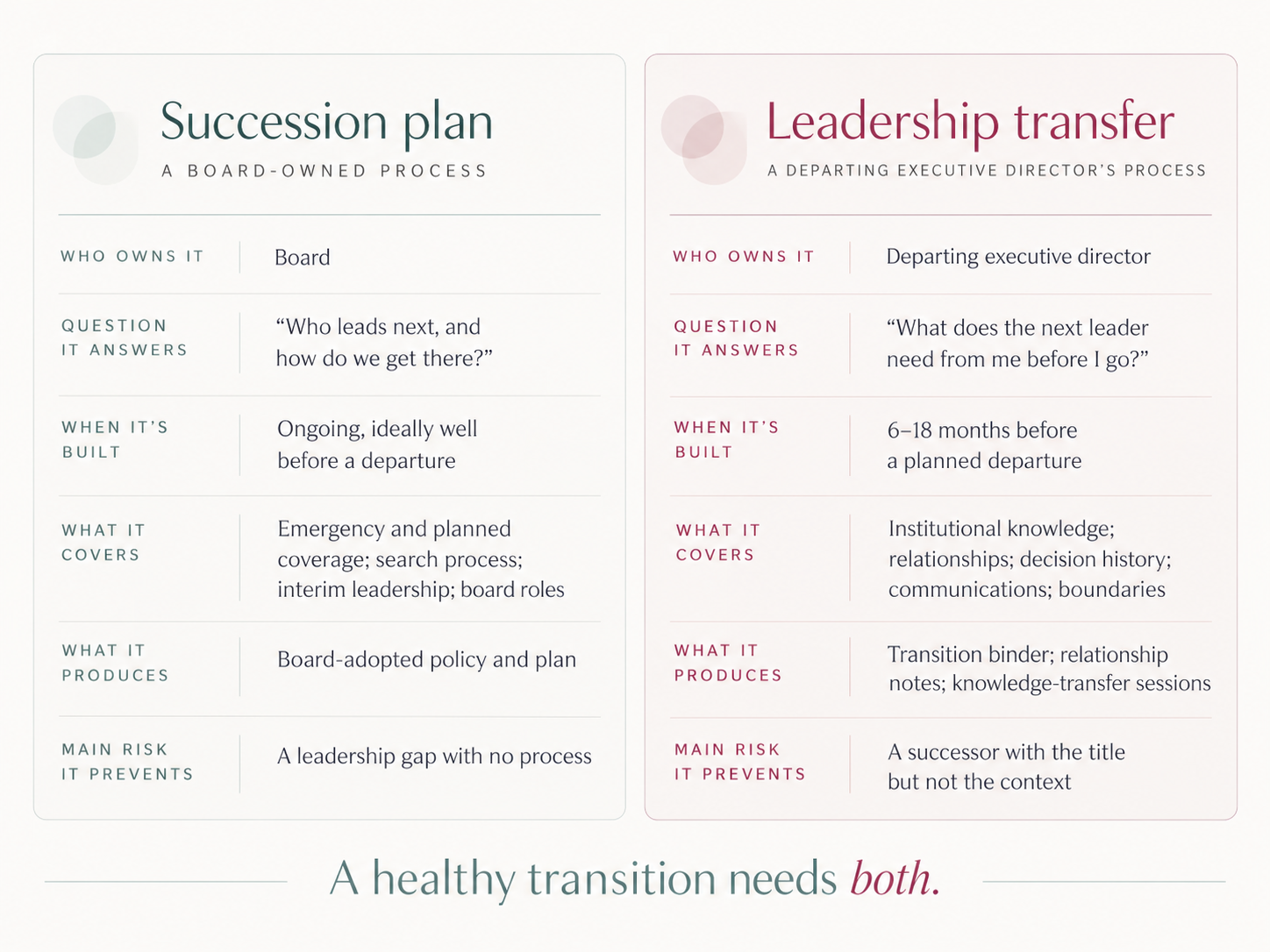
You need both. If your board doesn't have a succession plan yet, the 12-Week Succession Planning Guide walks you through building one together. If you're the one preparing to leave, The Legacy Leadership Transfer is the roadmap for your side of the work.
What comes next in Part 2
If you've read this far, you may already be doing the quiet math on your own role: how long you've been there, what lives only in your head, and who your successor would need to sit down with in the first month.
That's a good instinct to follow. It's also where a lot of leaders stall out, because knowing you need a leadership transfer and knowing where to begin are two very different things.
In Part 2, I'll walk through what I'd do first if I were thinking about leaving, and it comes before the conversation with your board chair. I'll also lay out the five TORCH stages of The Legacy Leadership Transfer and answer the questions I hear most from executive directors getting ready to go.

About the author:
Heather Hooper is the founder of Heather Hooper Consulting and a former nonprofit executive director. She spent about twenty years inside mission-driven organizations in North Carolina, more than ten of them in the executive director seat, and now helps executive directors and boards prepare for leadership transitions and build strategic plans that actually get used.